
NASA says: Asteroid 465824 (2010 FR), which can cross Earth’s orbit on September 6
NASA say's, asteroid, which is twice as big because the Pyramid of Giza, may cross the Earth’s orbit on September 6.
NASA has been tracking asteroid 465824 (2010 FR).
NASA Says, The space rock is estimated to live around 120 - 270 metres in diameter. At the upper end of that estimate, it suggests the asteroid might be around twice as big because the famous Pyramid of Giza!
it's classified as a Near-Earth Object (NEO) and a potentially hazardous asteroid (PHA).
NEOs occasionally move on the brink of the world as they orbit the Sun, and when this happens, NASA’s Center for Near-Earth Object Study (CNEOS) determines their distance. NASA defines NEOs as comets and asteroids nudged by the gravity of nearby planets into orbits that allow them to enter the Earth’s neighbourhood. These objects are composed mostly of water ice with embedded dust particles.
What is an asteroid?
Asteroids are small, rocky objects that orbit the Sun. Although asteroids orbit the Sun like planets, they're much smaller than planets.
Where did asteroids come from?
Asteroids are left over from the formation of our system. Our system began about 4.6 billion years ago when an enormous cloud of gas and mud collapsed. When this happened, most of the material fell to the middle of the cloud and formed the sun.
Some of the condensing dust within the cloud became planets. The objects within the belt never had the prospect to be incorporated into planets. they're leftovers from that point way back when planets formed.
Why do scientists track asteroids?
Scientists study them to seem for information about the formation and history of planets and therefore the sun, since asteroids were formed at an equivalent time as other objects within the system. one more reason for tracking them is to seem for asteroids which may be potentially hazardous.
NASA say's, there are estimated to be around 1 billion asteroids having a diameter greater than 1 metre. The objects which will cause significant damage upon impacting are larger than 30 metres. per annum, about 30 small asteroids hit the world, but don't cause any major damage on the bottom.
NASA say's, “Potentially Hazardous Asteroids (PHAs) are currently defined supported parameters that measure the asteroid’s potential to form threatening close approaches to the world. Specifically, all asteroids with a minimum orbit intersection distance (MOID) of 0.05 au or less are considered PHAs.”
Even so, it's not necessary that asteroids classified as PHAs will impact the world. “It only means there's an opportunity for such a threat. By monitoring these PHAs and updating their orbits as new observations become available, we will better predict the close-approach statistics and thus their Earth-impact threat,” NASA says.
NASA’s Near-Earth Object Observations Program finds, tracks and characterises over 90 per cent of the anticipated number of NEOs that are 140 metre or larger (bigger than alittle football stadium) – which, consistent with the space agency, are of “the greatest concern” thanks to the extent of devastation their impact is capable of causing. However, it's important to notice that no asteroid larger than 140 metre features a “significant” chance of hitting the world for subsequent 100 years.
How can asteroids be deflected?
Scientists have suggested alternative ways to keep off such threats, like berating the asteroid before it reaches the world, or deflecting it off its Earth-bound course by hitting it with a spacecraft.
The most drastic measure undertaken thus far is that the Asteroid Impact and Deflection Assessment (AIDA), which incorporates NASA’s Double Asteroid Redirection Test (DART) mission and therefore the European Space Agency’s (ESA) Hera. The mission’s target is Didymos, a binary near-Earth asteroid, one among whose bodies is of the dimensions that would pose a big threat to Earth.
In 2018, NASA announced that it had started the development of DART, which is scheduled to launch in 2021 with an aim to slam into the smaller asteroid of the Didymos system at around 6 km per second in 2022. Hera, which is scheduled to launch in 2024, will reach the Didymos system in 2027 to live the impact crater produced by the DART collision and study the change within the asteroid’s orbital trajectory.
NASA say's, asteroid, which is twice as big because the Pyramid of Giza, may cross the Earth’s orbit on September 6.
Updated: September 4, 2020 2:20 pm
 |
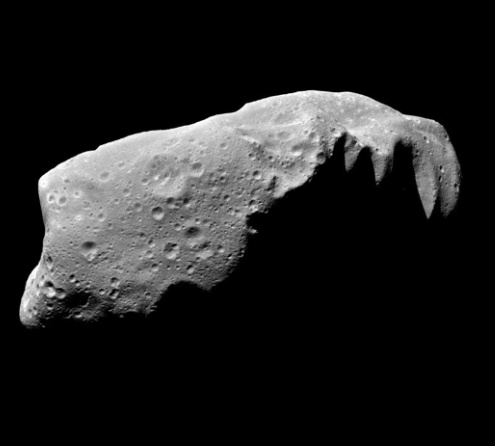
| A close-up image of the asteroid Ida taken by NASA's Galileo spacecraft. (Image credit: NASA/JPL-Caltech/UCLA/MPS/DLR/IDA) |
NASA Says, The space rock is estimated to live around 120 - 270 metres in diameter. At the upper end of that estimate, it suggests the asteroid might be around twice as big because the famous Pyramid of Giza!
it's classified as a Near-Earth Object (NEO) and a potentially hazardous asteroid (PHA).
NEOs occasionally move on the brink of the world as they orbit the Sun, and when this happens, NASA’s Center for Near-Earth Object Study (CNEOS) determines their distance. NASA defines NEOs as comets and asteroids nudged by the gravity of nearby planets into orbits that allow them to enter the Earth’s neighbourhood. These objects are composed mostly of water ice with embedded dust particles.
What is an asteroid?
Asteroids are small, rocky objects that orbit the Sun. Although asteroids orbit the Sun like planets, they're much smaller than planets.
Where did asteroids come from?
Asteroids are left over from the formation of our system. Our system began about 4.6 billion years ago when an enormous cloud of gas and mud collapsed. When this happened, most of the material fell to the middle of the cloud and formed the sun.
Some of the condensing dust within the cloud became planets. The objects within the belt never had the prospect to be incorporated into planets. they're leftovers from that point way back when planets formed.
Why do scientists track asteroids?
Scientists study them to seem for information about the formation and history of planets and therefore the sun, since asteroids were formed at an equivalent time as other objects within the system. one more reason for tracking them is to seem for asteroids which may be potentially hazardous.
NASA say's, there are estimated to be around 1 billion asteroids having a diameter greater than 1 metre. The objects which will cause significant damage upon impacting are larger than 30 metres. per annum, about 30 small asteroids hit the world, but don't cause any major damage on the bottom.
NASA say's, “Potentially Hazardous Asteroids (PHAs) are currently defined supported parameters that measure the asteroid’s potential to form threatening close approaches to the world. Specifically, all asteroids with a minimum orbit intersection distance (MOID) of 0.05 au or less are considered PHAs.”
Even so, it's not necessary that asteroids classified as PHAs will impact the world. “It only means there's an opportunity for such a threat. By monitoring these PHAs and updating their orbits as new observations become available, we will better predict the close-approach statistics and thus their Earth-impact threat,” NASA says.
NASA’s Near-Earth Object Observations Program finds, tracks and characterises over 90 per cent of the anticipated number of NEOs that are 140 metre or larger (bigger than alittle football stadium) – which, consistent with the space agency, are of “the greatest concern” thanks to the extent of devastation their impact is capable of causing. However, it's important to notice that no asteroid larger than 140 metre features a “significant” chance of hitting the world for subsequent 100 years.
How can asteroids be deflected?
Scientists have suggested alternative ways to keep off such threats, like berating the asteroid before it reaches the world, or deflecting it off its Earth-bound course by hitting it with a spacecraft.
The most drastic measure undertaken thus far is that the Asteroid Impact and Deflection Assessment (AIDA), which incorporates NASA’s Double Asteroid Redirection Test (DART) mission and therefore the European Space Agency’s (ESA) Hera. The mission’s target is Didymos, a binary near-Earth asteroid, one among whose bodies is of the dimensions that would pose a big threat to Earth.
In 2018, NASA announced that it had started the development of DART, which is scheduled to launch in 2021 with an aim to slam into the smaller asteroid of the Didymos system at around 6 km per second in 2022. Hera, which is scheduled to launch in 2024, will reach the Didymos system in 2027 to live the impact crater produced by the DART collision and study the change within the asteroid’s orbital trajectory.


, which can cross Earth’s orbit on September 6)
0 Comments